
Energy saving light bulbs are more than just a popular trend, they’re literally a ‘light saver.’ Although they cost about $5 more than the average bulb, they save approximately $30 or more per household during its lifetime by using 16 watts instead of 60 watts of energy. Using fewer watts, energy saving light bulbs generate less heat and allow homes to remain cooler. They’re proven to be 80% more efficient compared to a regular light bulb, so it’s no wonder that people are switching to a brighter solution.
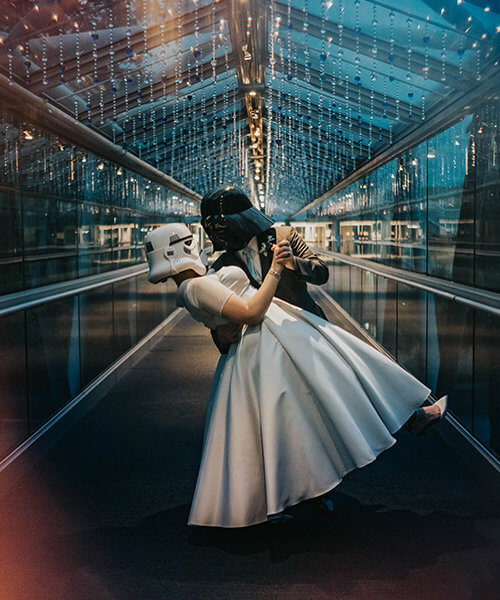
Over 500 cavemen and cavewomen stepped into the past on November 6 for Orlando Science Center’s fourth annual Neanderthal Ball. Guests arrived in style by showcasing their favorite animal print cocktail dresses, ties and prehistoric accessories. DinoDigs set the stage, providing attendees with the opportunity to dine beside STAN the T-Rex and slightly friendlier dinosaurs.
Capital Grille, Tim’s Wine Market and Orlando Brewing helped kick off the festivities by providing fine wine and delicious beer that flowed freely throughout the gala evening. The silent auction was the talk of the party, as some of Orlando’s most influential people traveled around the fourth floor rotunda bidding on items that were graciously donated by an array of spectacular sponsors. Exclusive travel packages, theme park attractions, wine and dining events, sports and golf outings and gift certificates were just some of the unique experiences and items offered.
The celebration continued throughout the night as our ancient friends enjoyed their meals, while rocking out to music and themed entertainment. Chief Meteorologist Jeff Day led the raffle drawings that included two round-trip Air Tran tickets, a Chauffered Dine-Around, as well as the best prize of the night, a half-carat diamond!
Due in part to this extraordinary fundraiser, dedicated Board of Trustees and devoted staff, the Orlando Science Center is able to maintain the mission and goal of inspiring science learning for life.
Composting is an easy way to reduce waste and it also benefits plants and soil. According to StopWaste.org, you need an equal proportion of browns, greens, air and water to make compost. Browns are dry, woody materials (leaves, shrub clippings, pine needles, newspaper, etc.) while greens are moist, nitrogen-fied materials (fruit and vegetable peelings, grass clippings, weeds, and the like). Mix the browns and greens equally and make sure the compost is kept as moist as a wrung-out sponge. Once your mixture has a nice, earthy smell and appears like coffee grounds, it’s ready to be used!
From 1975 to 1995 Florida was amongst the only four states that did not have any earthquakes; however, our state has not escaped all seismic shocks. For instance, in 1866, an earthquake in Charleston, South Carolina (two states away!) sent shocks throughout northern Florida and along its east coast. Of course this is nothing compared to the near 10,000 earthquakes of varying magnitudes occuring EACH year in southern California – luckily our state is not located on any hazardous faults or fault zones! If you want to see earthquakes and other forces of nature in action, check out the newest giant screen film playing at the Dr. Phillips CineDome, Forces of Nature.
Before the invention of telescopes, viewing stars was a difficult task because they blurred together in a white streak formation across the sky. An ancient Greek myth states that this white streak was coined ‘Via Galactica’ or “road made of milk” and is how our galaxy came to be known as the Milky Way.
Our solar system, along with hundreds of billions of stars, clouds of dust and gases lie throughout our Milky Way Galaxy. Imagine the galaxy like a pancake being stretched, with a huge bulge forming in the center. From there, huge groups of stars and dust particles fan out from the center, generating a spiral of curving, coiled and patterned arms.
Sometimes parts of the Milky Way can be viewed with the naked eye. On very clear, dark nights it appears as a band of milky starlight stretching across the sky. So the next time you look up at the night sky, you will know that the Milky Way is so much more than a candy bar!
Measuring and evaluating the brightness of stars can be traced back to the Greek astronomer and mathematician Hipparchus during 190 - 120 BC. He is responsible for producing a catalogue of comparative brightness and positioning of over 850 stars. Hipparchus formed the apparent magnitude scale to determine the brightness of a star as seen by an observer from earth.
How does this scale work? The brighter the celestial object appears, the lower the value of its magnitude. For instance, the faintest objects you can see using the naked eye are indicated with a magnitude of 6, while the Sun on the apparent magnitude scale is –26.74. However, most of the stars we gaze at in an urban neighborhood with our eyes are usually somewhere around 3 to 4 and if using binoculars, the limit is 10. More recently, through the use of the powerful Hubble Space Telescope, astronomers have located stars with magnitudes of 30+. It is this basic classification from over 2,000 years ago that led to the magnitude scale that we still use today!
Keep your eyes to the sky December 7 - 14, 2010 to catch a glimpse of the year’s most prolific meteor shower display, the Geminids. The Geminid meteoroids originated from dust grains left behind from Asteroid 3200 Phaethon. Every time the Earth passes through the dust cloud or meteor stream, we experience what is known as the Geminids meteor shower. The shower’s radiant - the point in the sky from which the shooting stars appear to be falling from - is the constellation Gemini, which rises above the eastern horizon after 9:00 p.m. local time.
Photo courtesy of National Geographic
Monday, December 13 will be the peak night, providing the chance to witness over 120 shooting stars in an hour, darting across the sky in various colors such as, blue, green and red. Mark your calendars, grab a blanket and head to a dark area from midnight until dawn for optimal viewing and an unbelievable show!
Orlando Science Center • 777 E. Princeton Street • Orlando, Florida 32803 • Phone: 407.514.2000 • Toll Free: 888.OSC.4FUN • Email: gservices@osc.org Supported by the City of Orlando, Orange County, and United Arts of Central Florida with funds from the United Arts campaign and the State of Florida, Department of State, Division of Cultural Affairs and the Florida Arts Council, and the National Endowment for the Arts. Privacy Policy